Professional Knowledge
Professional Knowledge
1. Know learners and how they learn.
1.1 Physical, social and intellectual development and characteristics of learners
Use teaching strategies based on knowledge of learners’ physical, social and intellectual development and characteristics to improve their learning.
The e5 Instructional model
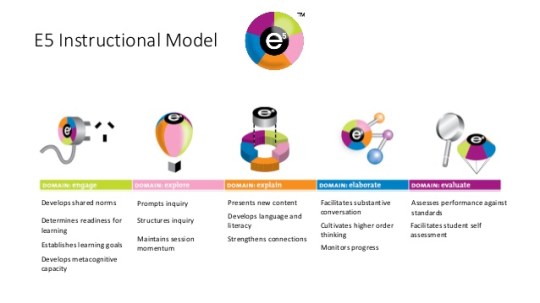
I have used this model in developing and teaching an integrated unit on Materials.
I have also been involved in a planning meeting at St Louis looking at how this model is used in integrated topics.
For Material world unit planner please click here and Integrated lesson sequence click here
For more information on the e5 Instructional model please click here
During the Materials unit Sandra utilised the E5 model. She brought the unit of work to life for the students by taking photos when they went outside to explore all of the Materials within the school environment, then placing the photos on the ‘Server’ to access immediately ready for the next session. Poppy Morris, Grade 4, P.L.P.S.
1.2 Understand how learners learn
Structure teaching programs using research and collegial advice about learning.
1.3 Learners with diverse linguistic, cultural, religious and socioeconomic backgrounds
Design and implement teaching strategies that are responsive to the learning strengths and needs of learners from diverse linguistic, cultural, religious and socioeconomic backgrounds.
1.4 Strategies for teaching Aboriginal and Torres Strait Islander learners
Design and implement effective teaching strategies that are responsive to the local community and cultural setting, linguistic background and histories of Aboriginal and Torres Strait Islander learners.
“Paul developed and planned sequential lessons on Aboriginal Art and Weapons and demonstrated a broad knowledge of their culture.” – Diana D’Angelo, Leading Teacher, Epping Primary School
1.5 Differentiate teaching to meet the specific learning needs of learners across the full range of abilities
Develop teaching activities that incorporate differentiated strategies to meet the specific learning needs of learners across the full range of abilities.
1.6 Strategies to support full participation of learners with disability
Design and implement teaching activities that support the learning and participation of learners with disability and address relevant policy and legislative requirements.
Ce Tool from NT government

I have incorporated Learning Management plans and dimensions of learning into different content areas.
I have included a Grade 4 Fractions learning management plan. Click here
De Bono thinking tools-6 hats

I have tried to incorporate these thinking tools in my lessons.
The De Bono thinking hats include;
The Six Thinking Hats
Blue Hat Thinking- Process
White Hat Thinking- Facts
Green Hat Thinking – Creativity
Yellow Hat Thinking- Benefits
Black Hat Thinking – Cautions
Red Hat Thinking – Feelings
For more information on De Bonos hats please click here
Gardner’s Multiple Intelligences

For more information on Gardner’s Multiple Intelligence Theory click here
Introduction was good, establishing starting point, what do they actually know about fractions (Fraction Buster) activity. Displaying on posters was a great visual for the students.
The activities set up for the children were thoroughly engaging and enjoyed especially the finale of making a Pizza, relating it to fractions and then eating it.
Great ice breaker activity to identify what students know about this Maths topic. Bringing the real world through using the newspapers really brought things to life for the students was fantastic. During this topic you showed a greater awareness of beginning to read the varying ability of the students and begin to plan follow up activities accordingly. This enabled you to move through the topic in a more flexible manner allowing for all abilities to be catered for.
Giving them the ‘hands on’ activity was more valuable, particularly for the students who are tactile learners.
Developing their understanding of the Australian currency and identifying what is on our coins and notes is a wonderful starting point to establish the varying abilities and understandings.
Your use of technology DVD brought her to life for the students and enabled them to really empathise and understand the true meaning of a hero.
Introducing the Military with a focus on Simpson & his donkey.
This was also a gem of a lesson. Using the imagery on her DVD really captured what the Military achieve for us on a daily basis. This lesson created a lot of discussion and information sharing between Sandra and the students. It also once again assisted the students with gaining a full understanding of what a true hero is.
Sandra shows dedication and effort will all her lessons implementing a variety of styles catering for a range of needs. This is demonstrated on a daily basis from the types of lessons planned and delivered to her interactions with students and other staff, often sharing resources and ideas.
Comments from Poppy Morris, Grade 4 Mentor Teacher, Patterson Lakes Primary School.
Blooms’s Taxonomy


| bloomspres.ppt |
Vygotsky’s Zone of proximal development and sociocultural theory

The ZPD helps to create an engaging and challenging classroom as children are provided with tasks that are neither boring and not just catering for their current acthievement levels, but stimulating and exploratory. With the assistance of educational support anxiety can be reduced and children can achieve higher levels independantly and be able to reach their full potential. Lessons must not be structured to be inachievable or boring but to address the gap which is the ZPD.
Vygotsky (1962;1978) believed that learning occurs when tasks or problems are correctly tailored to be just a shade above a child’s current level of ability but which the child can handle successfully with some support or guidance from an adult or peer (Westwood, pg 27, 2008). This approach, referred to as ‘scaffolding’, is supported in my class and I provide facilitation of the learning experiences as my students engage themselves actively in their learning discoveries. Assignment1 in ETL421
Kublin et al (1998) succinctly state that “Vygotsky (1934/1986) described learning as being embedded within social events and occurring as a child interacts with people, objects, and events in the environment” (p. 287).
For more information on Sociocultural theory please

Bruner-Discovery based learning

I like to give the children problems to work out and what strategies they should use. Open ended problems and critical thinking opportunities help to drive this learning.
For more information on Discovery Learning please click here
Understanding of the needs of the learner

This understanding of the needs of learners was reinforced in a professional development I attended on Behaviour Management at Patterson Lakes Primary School.
For more information on Maslow’s hierarchy of needs please click here
Piaget’s theory of cognitive development stages

For more information on Piaget’s cognitive development steps and theory please click here
 Paul Zula